Four ideas, working together: a root, a tree, a forest, and spaced repetition. Here's what each one actually does.
Every lesson starts with one word root: a small, real piece of English that carries a clear meaning but can't stand on its own as a word, like spect ("to look, to watch") or bene ("well, good"). You're not memorizing a list of thirty words; you're learning the one thing that unlocks all of them at once.
Roots are grouped into tiers: 10 standalone roots to start, then 12 that combine with another root into a shared word, then 4 hub roots that bridge to several others at once. You always start with the simple ones.
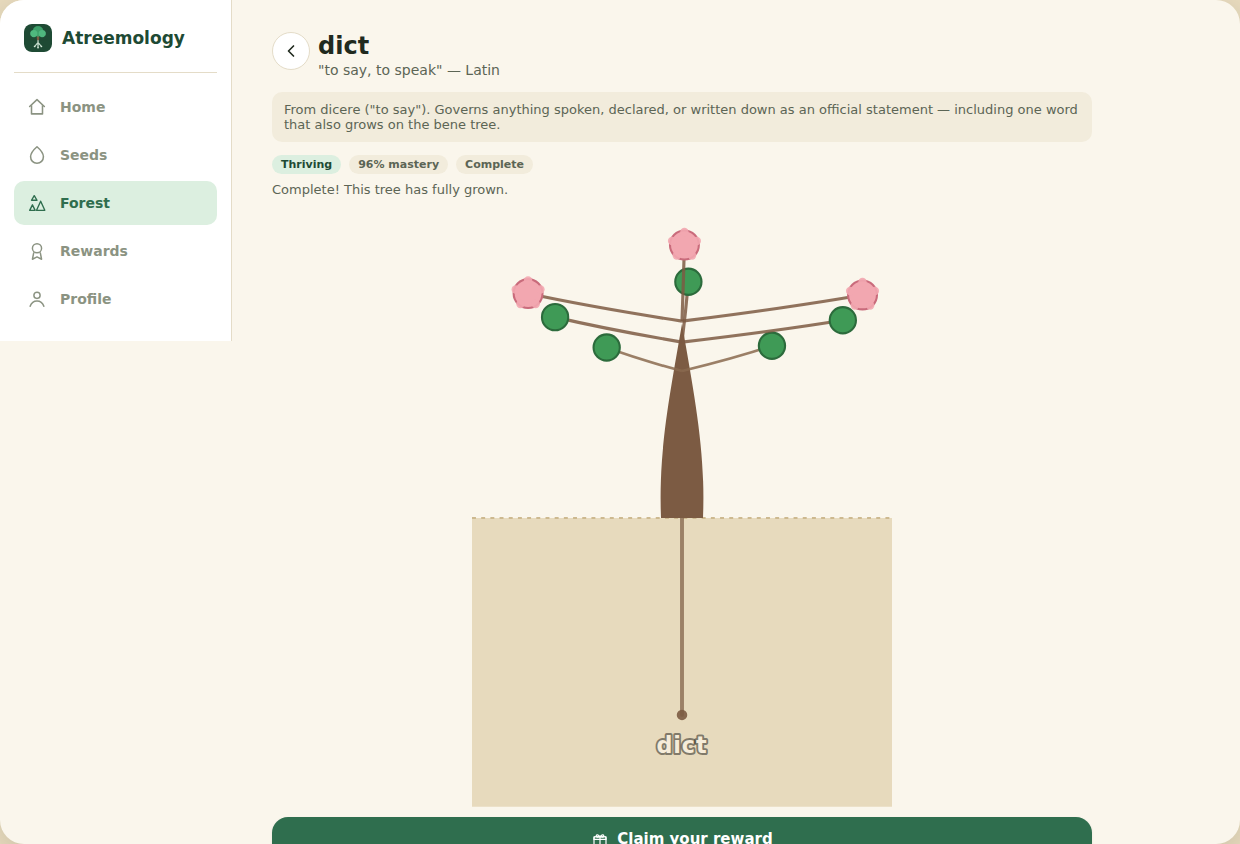
As you learn the words that share a root (predict, dictate, verdict for dict), each one renders as a real branch on the tree, not a checkbox on a list. A root is a bound piece of meaning, so it lives underground as the taproot; every actual word, no matter how basic, grows above ground where you can see it.
A tree moves through real growth stages as you learn more of its words (seed, sprout, branches, leaves, flowering, complete), so you can see exactly how close a root is to fully grown.
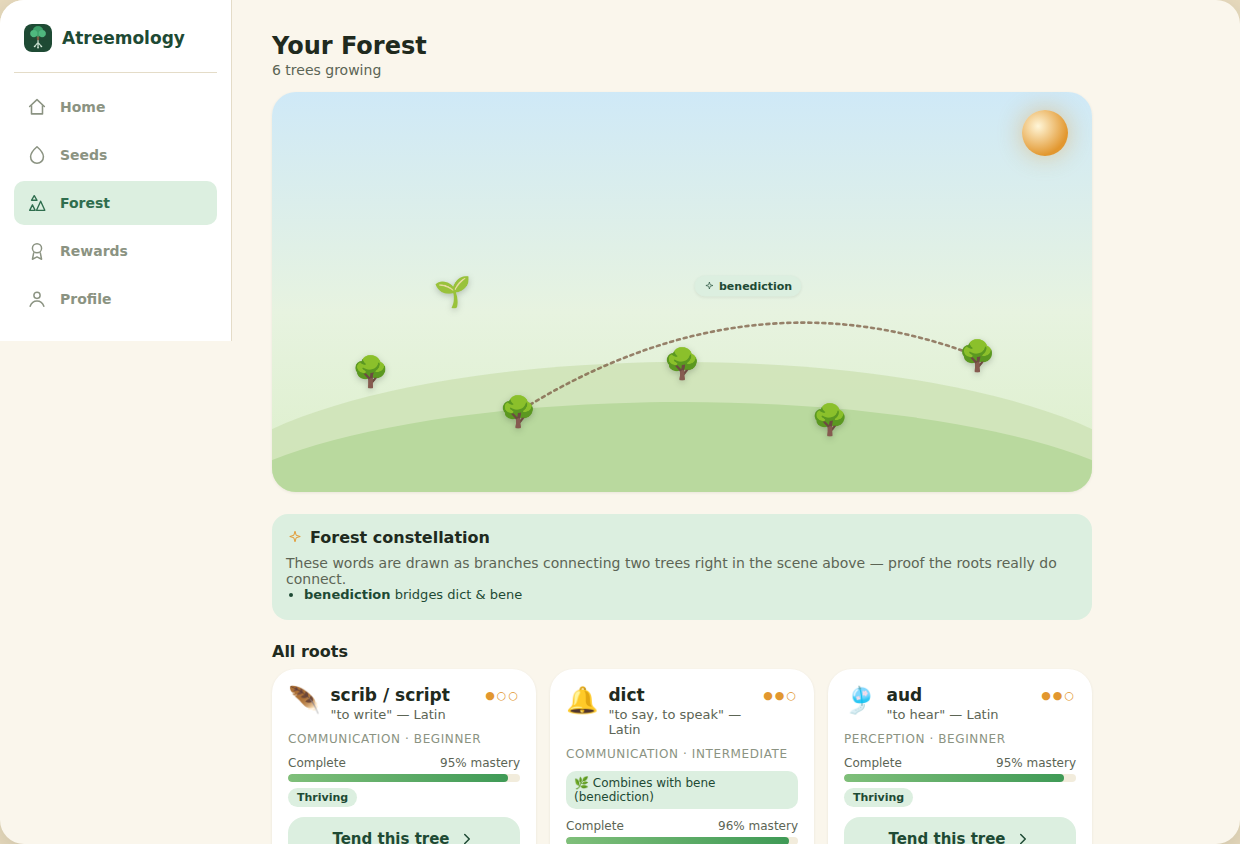
Word roots aren't independent: a lot of English vocabulary is built from more than one at a time, and Atreemology shows that directly.
Renders as a branch physically connecting the bene tree to the dict tree.
Connects the tele tree to the port tree; tele alone bridges to four different roots.
Even prefixes get their own small tree; spect alone bridges to six of them.
A finished tree doesn't disappear: it joins your forest for good, and spaced repetition keeps its words fresh without you having to think about it.
Every root you finish stays visible in your forest, a growing, visual record of real vocabulary work, not a score that can reset.
Rate a word again, hard, good, or easy, and it comes back in 1, 3, 7, or 14 days, right before you'd naturally forget it.
Every root planted and word learned is logged automatically, so you can look back and see exactly what you've built.
Achievements mark real progress (your first tree, your first ten roots, your first full grove), not arbitrary daily logins.
The full 26-root Foundational Grove is free to explore, no account required.
Start growing, it's free